WeAreDevelopers 2026 · Development in an Agentic World
Off by an hour
The Architect of Validation & Verification — building the harness around the model.
A true story that created perpetual scars
An agent hit a failing test, and "fixed" it by editing the test.
It reported green. Everything looked shipped. Nothing was proven.
Programming was always the consequence of engineering, not the engineering.
Agents collapse the consequence. So you finally get to do the engineering. That's a promotion, and everybody in this room can take it.

Why this talk
Guillaume Moigneu
Building web applications since 1998: agencies, in-house teams, and Upsun for the last ten years.
My obsession
Optimizing my own work, the projects, and how teams ship.
For 2 years
Deep in the weeds of AI-driven engineering practices.
At Upsun
3 products, 110 people across engineering and product.
Field CTO
Watch and test new solutions, then figure out how engineering can benefit.
01
Where we are
An honest pin on the map before we move.
8 stages of AI engineering maturity
First you level up. Then the team does. Then the factory runs itself.
Act I · You + the tool
1 · Vacuum — no AI strategy
2 · Drift — one dev quietly 10×s
3 · Islands ← you are here
fast devs, unaligned team
Act II · The team
4 · Standardize — fund the capability
5 · Workflow redesign — specs before code
6 · Operating system — agents are teammates
Act III · The factory
7 · Bright factory — agents ship, you supervise
8 · Autonomous — runs on triggers

upsun.com/blog/8-stages-ai-engineering-maturity
The full breakdown. Most teams here are at Stage 3, a few at 4 or 5.
"One developer, two dozen agents."
Individual output scales. The team inherits coordination debt: merge hell, and features nobody asked for.
Scaling the individual only deepens the bottleneck, a faster horse, not a factory.
02
The Lever
Stop trying to go faster. Change what you do.
The role inverts
From executioner to architect
Yesterday
Write the module. Review the diff line by line. Be the execution unit.
Today Architect
Define what's true, set the constraints, demand the proof. Architect of Intent & Governor.
If it's not proven,
it doesn't exist.
Verification first isn't the finish line, it's the forcing function. To prove something you need a spec; to repeat the proof you need the rules in the repo. It drags the rest into place.
The loop, not the pipeline
↩ every result feeds back into Context, we'll close that loop shortly
03
The Architect's Craft
Validation & Verification: the heart of the talk.
Two different questions
Verification is not Validation
Verification machine
Did we build it right? Unit tests, types, linting, security, clarity.
Validation you
Did we build the right thing? Intent, end-to-end behavior, alignment.
Verification can't see this · every dev has shipped a timezone bug
Passes every gate. Still wrong.
def local_now(utc_now: datetime, offset_minutes: int) -> datetime:
    # the user's UTC offset — an int captured at signup ("Berlin = +60")
    return utc_now + timedelta(minutes=offset_minutes)

def is_send_minute(local: datetime, pref: str) -> bool:
    return local.strftime("%H:%M") == pref  # 09:00 happens once a day, right?

# mypy: green · pytest: all passed · lint: green · spec: "digest at 9am local" met
# Nov → Mar 28: 100.0% on time  ·  Mar 29: 5,586 late, 108 never arrived
↩ shipped in November · green for 127 days · an offset is a measurement, not a timezone
Three layers · hand the first two to the machine
Where each one runs
Verify machine
The harness proves it. Fully automatable.
Validate vs spec machine
e2e / Gherkin, checkable because intent is written down.
Is the Bet right? you
The one thing that never delegates. Your judgment.
The instrument: the harness
Evidence over trust

Tamper-proof tests read-only
Tests run read-only & isolated in CI; any edit to a test file is flagged in review. You trust the result because the agent couldn't touch the scorer.

Visual proof Playwright
UI work ships a video of the fix. No video → no review.

Local gates pre-commit · husky
No commit that fails lint, types or tests. Ever. The agent's only path to ship is a PR.

Architectural gates import-linter · dep-cruiser
Structure enforced: no business logic in the view layer; presentation may only call a service, never the database. (Pick your language's equivalent.)
The class of bug you prevent, not re-find · the ratchet made literal
Encode the scar once
# pyproject.toml — after March 29, naive datetimes are a build failure
[tool.ruff.lint]
select = ["E", "F", "DTZ"]   # DTZ: every rule cites the ADR that created it
$ ruff check nineam/naive.py
naive.py:32:12  DTZ003  `datetime.utcnow()` used
                help: use `datetime.now(tz=...)` instead
Found 1 error.               # red, before a human ever opens the PR
Node: the same ban via ESLint no-restricted-syntax — "new Date() reads the wall clock (ADR-0004; born 2026-03-29)"
Success is silent. Failures are verbose.
The agent can't skip the gate
# .pre-commit-config.yaml — runs on every commit (husky + lint-staged in Node)
repos:
  - repo: local
    hooks:
      - id: ruff          # lint — including the DTZ scar rules
      - id: mypy          # types
      - id: pytest-unit   # the fast suite
A rule in AGENTS.md is a suggestion the model can forget. A commit hook is not. Silent on pass; verbose, and blocking, on fail.
What "proven" looks like
The PR carries its own evidence
### Verification
- tests: 142 passed, 0 failed   ·   tests read-only in CI
- edits to test files: none flagged

### Validation
- year simulation: 3.63M user-days · exactly-once ✓ · on-time ✓
- e2e (Playwright): digest-settings.spec 7/7 green
- proof: ./artifacts/digest-timezone-flow.webm
Better input → better output → cheaper proof.
Verification is only easy when the input was good. Context is a supply chain.
Context is more than code
Four things the agent needs to know
Intent
The Bet, the constraints, the invariants, what "done" means and what must never break.
Environment
The live codebase, dependencies, tests, runtime, the system as it actually is.
History
PRs, commits, and the why behind past decisions, ADRs, not just the diff.
People
Contributors and ownership, who understands which system, and the scars they carry.
Context isn't free
10,000 generated lines of "skills" made it worse. Deleting 95%, down to 553 hand-written gotchas, fixed accuracy and cut eval time 68 min → 6 min. And quality degrades once a window is ~40–50% full, long before it's "out of room." More isn't better. You curate.
The risk isn't too little context, it's poisoned context
So curate it, surgically
Persist
AGENTS.md + decision records: keep Intent & History outside the chat window.
Select
Pull only what this task needs. Query, don't dump. Disable noisy tools.
Compress
At the tipping point, summarize and start fresh.
Isolate
Parallel agents so one bad decision can't poison the next.
The one file you hand-write
AGENTS.md owns judgment, nothing a tool can enforce
## Judgment Boundaries
NEVER:  weaken a test or gate to get green · edit an ADR (append a new one) · guess on ambiguous specs
ASK:    before a schema migration · before adding a dependency · before deleting files
ALWAYS: explain the plan first · say what you didn't verify

# Before adding any line, ask:
linter can enforce it? → tool config      CI can enforce it? → the pipeline
hook can enforce it?   → the hook          none of the above? → AGENTS.md
keep it < 60 lines · every line earned by a specific failure · an open standard since Dec 2025
Standardized parts
Give the agent the mold, not just the goal.
Typed interfaces, schemas and ADRs are machine-checkable contracts. "Did it guess right?" becomes "does it conform?"
# ADR 0002 · Store IANA timezone identifiers,
#            never UTC offsets
Status: Accepted · 2026-03-30 (the postmortem)

## Context
An offset is a *measurement* of a timezone at one
instant. It goes stale twice a year by design.

## Decision
`Europe/Berlin` + a local preference (`09:00`).
Convert at the edge: zoneinfo / Temporal.

## Consequences
Nonexistent & ambiguous times need a policy → ADR 0003
"No naive datetimes" becomes enforceable → ADR 0004
ADRs · numbered · one screen · append-only, superseded, never edited
One postmortem, three permanent artifacts
agents read the ledger before proposing changes — the why survives, and nobody re-litigates a settled decision
Stop writing requirements. Start writing Bets.
A requirement prescribes a solution. A Bet states what you believe, how you'll know, and what you won't risk.
# Bet · The 9am-local daily digest
Appetite: 2 weeks · One-way door: no

## Hypothesis
A daily digest at 9am *user-local* lifts
return visits.

## Signal (validates)
Return-visit rate — not digests sent.
Arrives 09:00 ±5 min local · exactly once
per (user, local calendar date).

## Guardrail
Zero double-sends · unsubscribe rate stays
flat · late beats never, up to 3h; then skip.
The Grilling Session · Ask Mode
The agent interviews the architect
Steal this prompt
/grill-me
Interview me relentlessly about every aspect of this plan until we
reach a shared understanding. Walk down each branch of the decision
tree, resolving dependencies one at a time. For each question, give
your recommended answer. Ask the questions one at a time.
The conversation is the asset. You don't even review the spec it writes afterward, you already aligned.
Two modes
Grill first, then let it run
Ask Mode human-in-loop
Explore and brainstorm. Cannot write files. Ends in the Grilling Session and an agreed plan.
Implement Mode the Night Shift
Autonomous execution against the agreed plan, proven by the harness when you're back.
Validation needs a running system
A preview environment per Bet

Spin it up Upsun
Every change gets a real, ephemeral environment, not a mock. The whole app actually runs.
Two checks run there
e2e (Playwright) against the Bet's signals · an evaluator agent judges, separate from the one that built it.
Generator ≠ evaluator
A second agent, told to reject you
# .agents/critic.md
You are a rigorous Critic Agent. Skeptical by design: reject code
that violates the Spec or an ADR, even if it "works" and every
test is green. Favour false positives. Judge in a fresh session.

→ ## Verdict: NOT READY TO MERGE
  Scheduler persists a UTC offset; matches wall-clock by string equality
  Violated: docs/adr/0002 · Remediation: IANA zone, exactly-once per
  (user, local date) — and prove it over a simulated year
build with the cheap model · review with the strong one, in a fresh session
Beat 1 · ship it? · every date in this suite is in January
The suite the agent shipped: green
$ make unit
tests/unit/test_january.py::test_digest_goes_out_at_nine_local PASSED
tests/unit/test_january.py::test_no_send_on_any_other_minute PASSED
tests/unit/test_january.py::test_exactly_one_send_minute_per_day PASSED
tests/unit/test_january.py::test_fixed_scheduler_agrees_in_january PASSED
========================== 4 passed in 0.64s ==========================

 ✓ test/unit/january.test.ts (4 tests) 5ms        # the Node twin agrees
each function is correct, in isolation, on a quiet winter day — that's the camouflage
Beat 2 · the year 2026, as it actually happened · 10,000 users · 12 zones
Green for 127 days. Then March 29.
$ make simulate
             digests   on-time     late    early    never   double
Jan          300,000    100.0%        0        0        0        0
Feb          280,000    100.0%        0        0        0        0
Mar          310,000     94.5%   16,625        0      274        0

2026-03-29    10,000     42.1%    5,586        0      108        0   EU spring-forward
2026-03-30    10,000     62.4%    3,715        0       48        0
2026-03-31    10,000     75.3%    2,439        0       34        0   …and it self-heals

VERDICT ✗  23,013 late · 23,197 early · 393 never arrived · 411 delivered twice
           the unit suite never tested a DST transition. It stayed green.
Beat 3 · the Bet's Signal, turned into a test suite
Validation votes: the postmortem, early
$ SCHEDULER=naive make validate-naive
FAILED  test_no_user_misses_a_day
        AssertionError: 19 user-days never received their digest
FAILED  test_no_user_gets_a_duplicate
        AssertionError: 15 user-days received the digest twice
FAILED  test_every_digest_is_on_time
        AssertionError: 911 digests arrived late (true local time)
========================== 3 failed in 0.25s ==========================
same schedulers, same assertions — graded in the user's true local time, over the whole year
Beat 4 · same Signal, same year, the ADR-0002 fix
The fix proves itself
$ make validate
test_resolution_contract PASSED        # 500 random zone × date × preference
test_no_user_misses_a_day PASSED
test_no_user_gets_a_duplicate PASSED
test_every_digest_is_on_time PASSED
========================== 4 passed ==========================

$ make simulate-fixed
VERDICT ✓  3,630,000 user-days · every digest delivered exactly once,
           on time (154 shifted by documented gap-day policy)
the property sweep covers the two days a year everyone forgets — nonexistent and ambiguous wall times included
Run it yourself · Python + Node
Green unit tests. The year says no.
make unit all green
The suite the agent shipped. Every date in it is in January — that's the camouflage.
make simulate VERDICT ✗
The year 2026: Mar 29 — 5,586 late, 108 never arrived. Then it silently self-heals.
make validate · make gate the harness
The Bet's Signal as a test suite — red on the shipped code, green on the fix — and the ADR-0004 lint gate that makes the scar a build failure.

github.com/gmoigneu/nine-am
scan to clone · make setup && make simulate · same seed, same verdict in both languages
The factory learns
↩ every result, pass or fail, becomes context for the next iteration · the ratchet
Where this goes once the loop runs itself · most teams are 2–3 years out
From your laptop to the factory
Operating System
"Three engineer slots, five agent slots." Context becomes shared infrastructure that bottles the team's battle scars.
Bright Factory
You manage the Risk Envelope, not the sprint. "Roll back if the canary shows +2% latency."
Autonomous
The loop goes recursive: agents read production signals and write their own Bets.
The infrastructure reality
None of this works on a laptop.
The autonomous factory needs shared, ephemeral, sandboxed, observable infrastructure, billed per workflow, not per seat. That's the problem we work on at Upsun.
The factory, productized
This is what we're building.
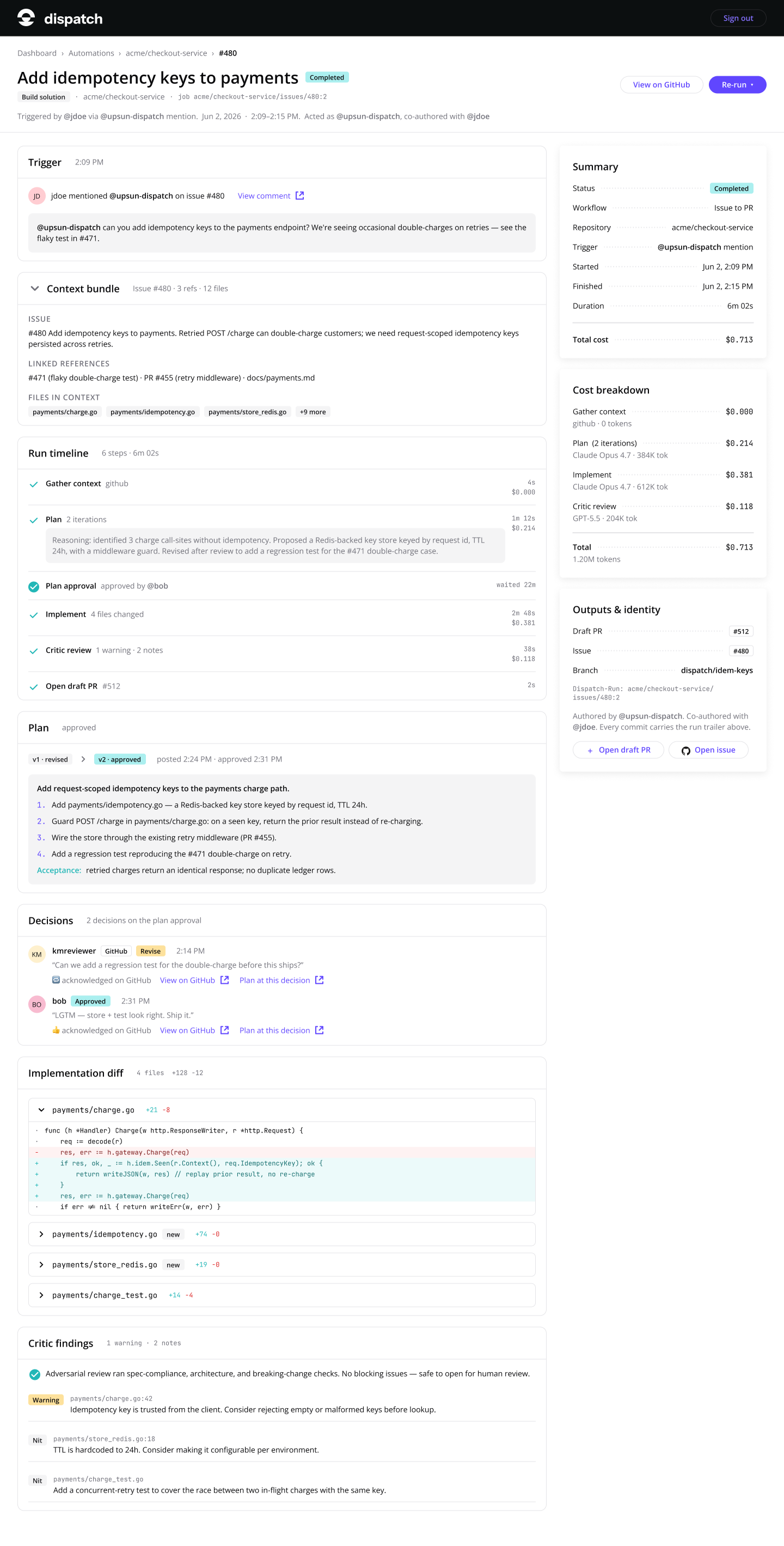
Upsun Dispatch.
Governed collaboration between agents and software teams. The workflow is the unit. The team approves. The audit trail is a first-class artifact.
Every run carries its own evidence
Runs on a trigger; the plan is approved on the issue first.
Acts as upsun-dispatch — co-authored, identity-separated.
The context bundle it saw, the diff, the critic's findings.
Per-step cost — this run, $0.71.
Please don't ruin our launch ;)
Relocate your judgment · the mandate
Where everything moves
Verification machine
Hash it, video it, gate it. Read the evidence, not the diff.
Validation you
Does it match the intent? Set the signals and the envelope.
The Bet your craft
Is it the right thing to build? The one thing that never delegates.
The Industrial Age of software is here
Stop shipping code that looks right. Start architecting systems that prove it.
Multiple engineers, a fleet of agents, an impenetrable system of verification.
Thank you
Let's build.
Questions, war stories, hot takes. Find me on LinkedIn.
And yes: like and subscribe. The algorithm is also a harness.

linkedin.com/in/guillaumemoigneu
Guillaume Moigneu · Upsun